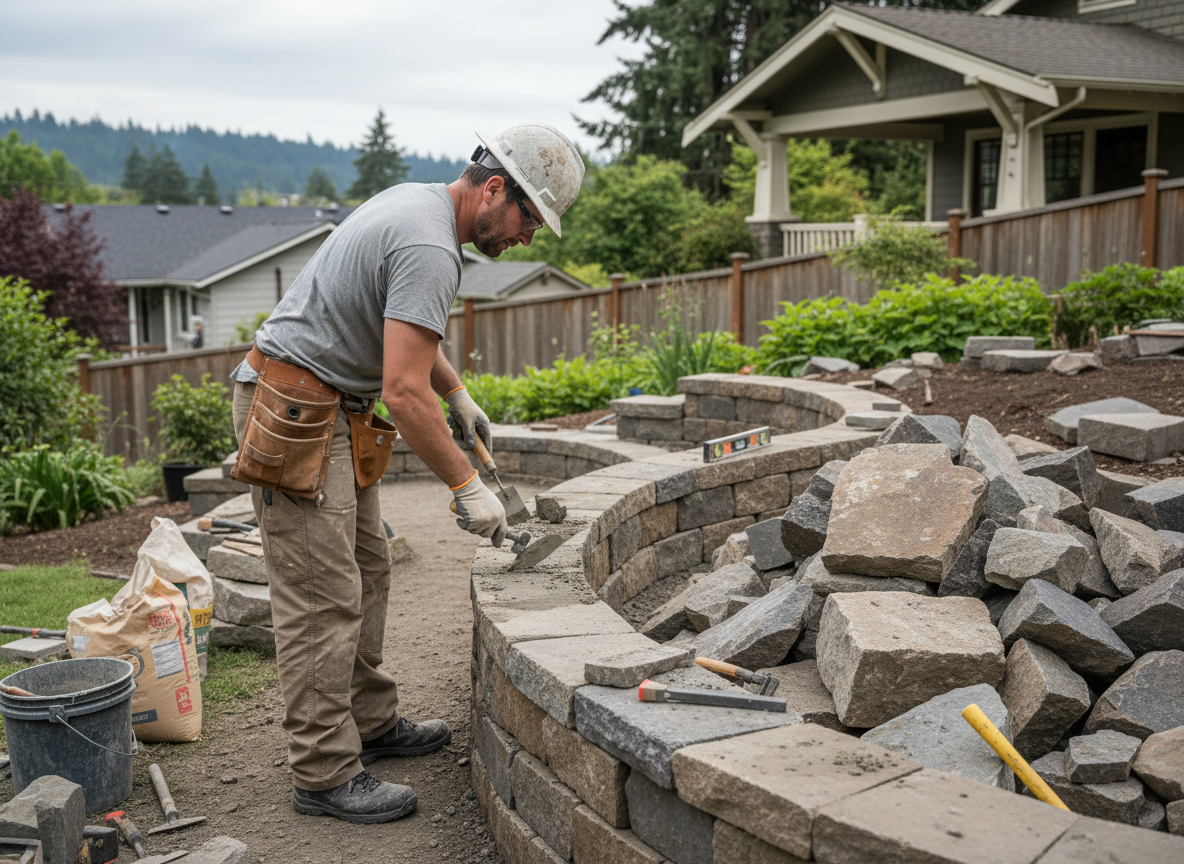
Masonry landscape walls in Milwaukie must account for the heavy clay soils common along the Willamette River and in lower-lying spots of Island Station and Ardenwald. These soils expand and contract with the mild wet winters, creating lateral pressure that can push standard walls out of plumb within a few seasons. Proper base preparation with compacted gravel and perforated drain tile behind the wall becomes essential to move water away before it saturates the backfill. Stone or block choices also matter; denser materials resist the freeze-thaw cycles that occur even in Clackamas County’s relatively mild climate.
Homeowners in Hector Campbell and Downtown Milwaukie often request walls to terrace sloped yards or create raised beds near older foundations. Many properties here date from the mid-20th century, so existing footings and utilities frequently sit shallower than current codes require. We excavate to solid subgrade, install geogrid reinforcement on taller runs, and compact each course to prevent settlement that shows up after the first heavy spring rains. Walls built without these steps commonly lean toward the Willamette or crack along mortar joints once summer irrigation begins.
Drainage details separate a wall that lasts from one that fails in this area. We run drain tile to daylight or a sump, wrap it in filter fabric, and backfill with clean crushed rock rather than native soil. In Portland-adjacent jobs, we also check for seasonal groundwater that rises close to the surface during wet months. Adding weep holes at regular intervals and capping the wall with a sloped concrete or stone coping keeps water from entering the cores and freezing.
Technician insight
In Milwaukie, the thing that catches most people out with masonry landscape walls is the heavy clay along the Willamette River and in Ardenwald that holds water through our mild wet winters. Homeowners skip the drain tile and geogrid because the ground looks firm in summer, then watch the wall lean after the first big spring rain. We always excavate deeper and daylight the drain line rather than trusting native soil.
Island Station Retaining Wall
A homeowner in Island Station needed a new wall to stop soil sliding toward the lower patio after winter rains. We found saturated clay pushing against an old stacked-stone wall with no drainage. We removed the failing stones, installed a perforated drain line to daylight, added geogrid, and rebuilt with segmental block on a compacted gravel base. The new wall has stayed plumb through two wet seasons.
How it works
- 1
Site Visit and Soil Assessment
We walk the property in Milwaukie to check slope, drainage paths, and proximity to the Willamette River or existing structures.
- 2
Design and Material Selection
We choose block or stone suited to local clay soils and winter moisture, then provide a drawing showing height, reinforcement, and drainage layout.
- 3
Excavation and Base Preparation
We dig to firm subgrade, install compacted gravel base, and place drain tile before the first course.
- 4
Wall Construction and Backfill
We lay each course with proper batter, install geogrid where needed, and backfill in lifts while compacting to avoid future movement.
- 5
Final Grading and Cleanup
We slope the top cap for runoff, restore disturbed areas, and leave the site ready for landscaping.
Pricing
Upfront written quotes after site visit; price varies with height, length, soil conditions, and access in neighborhoods like Ardenwald or near Milwaukie Riverfront Park.